Movements · mainspring to balance wheel · a deep dive
How a mechanical watch works
A spring wants to unwind all at once. Everything else inside the case exists to stop it — and to let it go in equal, countable pieces.
The whole machine fits in one sentence: a spring drives a set of gears, the gears are forbidden to turn except in tiny identical steps, a swinging wheel sets the rhythm of the steps, and the hands simply report the count. Every part of a mechanical movement — and there are usually well over a hundred — belongs to one of those four jobs. This article walks the power from the spring to the hands, slowly, with the machinery animated along the way.
The mainspring stores the power
Open the back of a movement and the largest single part is a shallow drum called the barrel. Coiled inside is the mainspring: a ribbon of hardened alloy roughly the proportions of a long strip of paper, wound around a central post called the arbor. Winding the watch rotates the arbor and wraps the spring tight; for the next couple of days the spring pushes back, turning the barrel slowly around it. That is the entire power source. Nothing is burned and nothing is stored chemically — a mechanical watch is a machine for letting one spring straighten itself out over forty or more hours instead of half a second.
How long the spring can run the watch is the power reserve, typically 38 to 80 hours in a modern movement. A watch that sat in a drawer over a long weekend and stopped is not broken; it is out of fuel. Wind it, set it, and it is a watch again.
The engineering problem is that a spring does not push evenly. Fully wound it shoves; nearly flat it barely leans — and a balance wheel fed varying force will swing through varying arcs, which threatens the timekeeping itself. Three centuries of answers are visible in movements today: better geometry (the modern spring is pre-formed into a reverse curve so its torque flattens through the middle of its run), better metallurgy (cold-rolled multi-metal alloys of the Nivaflex type replaced plain carbon steel, which also ended the era of mainsprings simply snapping), longer springs in bigger barrels, and sometimes two barrels in series sharing the load so each works only in the flattest part of its curve. Antique watches went further and coupled the barrel to a cone-shaped pulley called a fusee — a continuously variable transmission from the 1400s — purely to level the spring's temper.
The gear train divides it down
Between the barrel and the part that measures time runs a chain of wheels, each pair stepping speed up and force down, exactly like a bicycle ridden in reverse. The barrel turns about once in six hours with considerable force; four wheels later, the escape wheel is turning once every few seconds with almost none. Along the way the train drives the hands: the center wheel turns once an hour and carries the minute hand, a small side-branch called the motion works gears that down twelve-to-one for the hour hand, and the fourth wheel turns once a minute and traditionally carries the seconds.
The scale of the division is worth feeling. Ask a watch to run 40 hours on a wind and its seconds hand must make 2,400 rotations while the barrel makes about seven — a step-up near 343:1, hopeless for any single pair of gears and easy for four stages compounding. (This arithmetic follows Bartosz Ciechanowski's walkthrough — see Further reading.)
The ratios are fixed at manufacture, which has a consequence worth pausing on: the hands cannot lie independently. If the far end of the train is honest about time, the minute hand is honest by arithmetic. Everything therefore depends on how honestly the train is allowed to turn — and left to itself, it would not turn honestly at all. It would spin the mainspring flat in seconds, hands blurring, and stop. Something has to forbid that.
The escapement is the difficult part
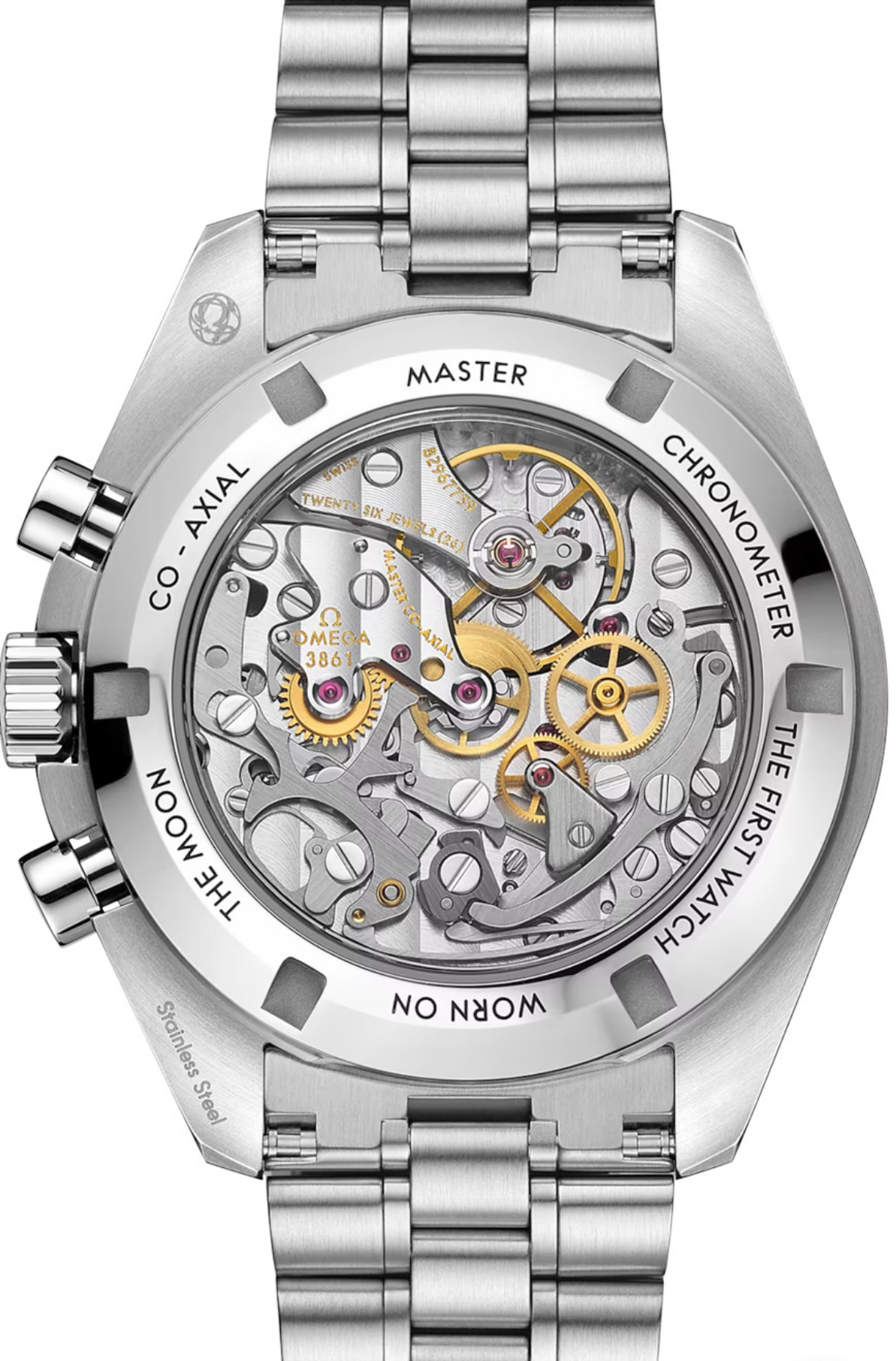
The escapement is the forbidding mechanism, and it is where watchmaking earned its difficulty. A two-armed lever — the pallet fork — rocks between two positions. In each position, one of its two jewelled pallet stones is planted in the path of the escape wheel's teeth, locking the entire train solid. Each rock of the lever frees one tooth, and the wheel — shoved by the whole might of the mainspring behind it — advances by exactly one step before the other stone catches it. The train can only move in identical clicks. Time, in a mechanical watch, is literally the count of those clicks; the tick you hear is the escape wheel's tooth landing on the next stone.
The transaction runs both ways. As each tooth escapes, it slides across the angled face of the pallet stone and gives the fork a push, and the fork passes that push to the balance through a tiny jewel pin. That is the balance's fuel — just enough energy per beat to replace what friction and air resistance stole from the last swing. Meter the train, feed the meter: this closed loop is the heart of every mechanical watch, and its refinements have their own vocabulary. Draw is the slight angle that suctions the fork safely against its banking pins between beats so a jolt cannot unlock the train early; the guard pin is the failsafe that makes accidental unlocking mechanically impossible. A handful of alternatives to the lever exist — most visibly Omega's co-axial escapement, which splits the duties across two wheels to swap the lever's sliding friction for pushing contact, chasing longer service intervals — but they are variations on the same contract: hold everything still, let one tooth go, pay the balance for its trouble.
The balance is the timekeeper
Everything so far is plumbing. The part that actually keeps time is the balance: a weighted wheel on jewelled pivots, coupled to a coiled hairspring finer than a human hair. Twist the wheel and the spring twists back; let go and it overshoots, is pulled back, overshoots the other way — a rotating pendulum that does not care which way is down. Its period depends, to first order, on just two things: the wheel's inertia and the spring's stiffness. Not on the force of the push, which is the property — isochronism — that makes the whole architecture workable: as the mainspring fades over two days and the balance's arc shrinks from a turn and a half toward a single turn, the time of each swing stays almost the same.
The rate is quoted in vph, vibrations per hour — one vibration being a single swing. 21,600 vph is six beats a second and gives the classic gentle tick; 28,800, the modern norm, is eight and averages the disturbances of a moving wrist better; a few movements run 36,000 for a seconds hand that pours. The choice is a bargain between stability, power draw and wear. It is also what gives a mechanical seconds hand its signature glide: not sweeping at all, but stepping six or eight times a second, too fast for the eye to separate.
Adjusting the oscillator is its own craft. Traditional movements carry a regulator lever that shortens or lengthens the hairspring's working length — a faster or slower spring by a whisker; finer movements are free-sprung, leaving the spring alone and tuning inertia through small weights on the balance rim, which holds its setting better through shocks. History's great enemies of the balance have been dealt with one by one: temperature (a plain steel spring slackens when warm) fell to self-compensating nickel-iron alloys in the early 1900s; position — a watch runs slightly differently dial-up than crown-down, as gravity loads the pivots unevenly — is beaten down by poising the wheel and adjusting in five or six positions; and magnetism, the modern menace of laptop lids and headphone cases, is increasingly dismissed entirely by non-ferrous silicon hairsprings and escapement parts.
Jewels, shock, and oil
The famous rubies are bearings, nothing more mysterious than that. A steel pivot turning in a brass hole wears the hole oval in a few years; the same pivot turning in pierced synthetic corundum — sapphire and ruby are the same crystal — runs for decades, because almost nothing is harder, and the polished jewel holds its drop of oil in place by surface tension. A typical automatic carries around two dozen: hole jewels for the train, cap jewels on the balance to take end-thrust, and the pallet stones and impulse pin of the escapement itself. The count stopped being a bragging metric once jewels became cheap; what matters is where they are.
The balance pivots, finest and most loaded, get one more layer of defence: spring-mounted jewel settings — Incabloc is the name to know — that let the jewel shift under a blow and snap back centred. Before shock protection, dropping a watch onto a wooden floor was a pivot-snapping event; after it, watches started surviving their owners' wrists. The quiet consumable in all of this is the oil. A movement holds a fraction of a drop, applied under a microscope in a dozen specific places, and its slow thickening over five to eight years — not broken parts — is what a routine service actually addresses.
Winding, by hand or by rotor
A hand-wound movement takes its energy at the crown: thirty-odd turns against the ratcheting click — the second tick you can hear — until the mainspring's outer end, hooked to the barrel wall, will take no more. An automatic adds a weighted half-disc rotor swinging on the wrist's every move, geared down through reversing wheels so both directions of swing wind the same way. Since a rotor cannot know when to stop, the automatic mainspring's outer end is not hooked but held by a slipping bridle: at full wind it slides along the barrel wall, and a day at a desk or a day of yard work both end at safely, not dangerously, full.
Underneath, hand-wound and automatic are the same watch; the rotor only saves you turning the crown, at the cost of hiding the movement behind a swinging weight. That some celebrated movements still wind only by hand is partly tradition, partly thinness — and partly the view.

What accurate means here
A good mechanical watch drifts by seconds per day. The classic chronometer standard, COSC, demands −4 to +6 across positions and temperatures; Omega's METAS Master Chronometer layers 0 to +5 on top, tested after that 15,000-gauss magnet; fine adjustment beyond the standards is the quiet pride of individual brands. Set against quartz's seconds per month this sounds like defeat, but consider what is being asked: a purely mechanical oscillator, running on a fading spring, strapped to a moving arm, holding itself to a few parts per million. It remains partly a craft: the last seconds per day are found by a person at a bench, adjusting a wheel that will swing a quarter of a billion times before its next service.
Two practical notes follow from the mechanics. Magnetism is the everyday hazard for older or unprotected movements — a magnetised hairspring's coils stick together, shortening the spring and sending the watch wildly fast; a watchmaker's demagnetiser fixes it in seconds. And a mechanical watch measures its owner a little: it runs slightly differently face-up on a nightstand than crown-down, so where you leave it overnight is, in effect, a one-position regulator anyone can use.
Complications are more gear-work, not more magic
Everything beyond hours, minutes and seconds is a complication, and nearly all of them are additional gear-work grafted onto the same four-part machine. A date is a 31-tooth ring nudged once a day; a GMT adds a second hour hand geared at half speed to a 24-hour scale; a chronograph is a second, stoppable branch of the gear train with its own clutch and brakes, which is why it is the complication watchmakers respect — it couples and uncouples a running machine on demand. The heart does not change: one spring, one train, one escapement, one balance. Complications spend the train's motion in cleverer ways; none of them touches how time itself is kept.
Why any of this matters
Most of what reads as jargon on a specification page is this one machine seen from different angles: power reserve is the mainspring, vph and jewels are the train and escapement, manual versus automatic is only how the spring gets fed, chronometer certification is the balance's report card. And the deepest divide in modern watchmaking — mechanical, quartz, and the strange third case that borrows from both — comes down to what does the counting: this balance wheel, beating eight times a second, or a crystal vibrating 32,768 times in the same interval. That comparison has an article of its own.
Further reading
Bartosz Ciechanowski's Mechanical Watch is the finest interactive explanation of this machine anywhere: a full 3D movement you can rotate, scrub through beat by beat, and take apart, from mainspring to keyless works. This article owes it two debts, gladly acknowledged — the 40-hour/2,400-turn gear-train arithmetic above follows his walkthrough, and the speed-marker dots on the train diagram borrow his device of painting a dot on each wheel so relative speeds become visible. Viewing his rendered demos also informed three redrawings here: the escape wheel's leaning hooked teeth, the fork's slotted horns that the balance pin enters, and the dense packing of the coils. His graphics are his own (© Bartosz Ciechanowski) and nothing here reproduces them; the diagrams on this page are original drawings.
Deeper still: George Daniels's Watchmaking is the standard modern reference on how these mechanisms are actually made, and the Wristwatch Revival channel shows real movements — often seized, rusted, or worse — stripped, cleaned and brought back to the beat, which is the best possible demonstration that a mechanical watch is designed to be rebuilt forever. Both recommendations come via Ciechanowski's own reading list.
The animated diagrams are original to this article, drawn and animated in SVG, with speeds slowed or exaggerated for legibility as noted in each caption.